Sometimes, not too often, but sometimes these little inklings of doubt creep into my mind. "What if we move to Africa and one of us dies of cholera?" "What if it ruins my kids?" "What if I can't hack it?" And then I remember that nobody has told me I have to do this. When the thoughts were just hatching in our minds, before we would have admitted it even to each other, there was something compelling about the idea. The more we googled and blog-stalked, the more we were hooked. Now if you have googled or blog-stalked Burundi at all, you may have heard that it's not exactly on the top-ten list for vacation spots. There's nothing about living there that is easy. But we still wanted to go. Let me say that again. We want to go.
Once we started to question ourselves, we spent a long time wondering why in the world we wanted to go. We honestly tried to figure this out. "We are just idealizing the equatorial climate," (which is not an inconsequential thing to consider in February in Idaho). "We are just glorifying the idea of living in community with this remarkable group of doctors and their families." We postulated all sorts of reasons that we would find the idea both compelling and appealing. Malaria? No, not that. Scars from years of genocide and mass killings? Not really. Hmmm...
After these questions had been swirling in our minds for several months, we began to wonder if maybe we were "called" to go to Africa. You know, like really super-spiritual amazing people-of-God are "called." We were having a conversation about this with a friend, and his response was gold. He asked if it was a normal response to see this kind of poverty and want to live in the midst of it. "Do you see people around you giving up their jobs and their friends and their churches and their homes and all that is comfortable and just deciding one day to go live in the world's poorest country for fun?" Well, I guess not. "Why do you think you want to do that? Why do you have the desire to teach dentistry there and not in Seattle? Why do African adventure and community living appeal to you?" (In case it's not as obvious to you as it was to us upon hearing these things, the resounding answer to these questions was "Duh! It's because God created us with these interests and curiosities that we have this desire!"
So to sum up, yes--we feel "called" to go to Africa. Not called in a booming, fun-squashing, Charlton Heston voice, demanding us to give up everything fun and go live in a dusty hut and corral natives into white buildings with steeples, but called in a beckoning, enticing sort of way. We hear a provocative invitation to go be part of something already moving, to learn from people who have so much strength and charisma and eminence of spirit (but no toothbrushes!). And we want to glorify God in that, just as much as we aim to glorify Him here in our northwoods hayfield.
*So if you are wondering what finally kicked my butt back into blogging gear after a two-week silence, you can thank Jason Fader and the strong-bodied men of Kibuye. Go read Jason's post here, or at the very least, watch the video clip at the end of his post.
Monday, October 14, 2013

Tuesday, October 1, 2013
Little Joys
One thing that can almost always bring a smile to my face is watching my boys enjoy throwing rocks into the water. It's something so basic, so simple, and yet somehow so thoroughly entertaining. It is a show of strength (how big your rock is, how hard you had to work to dig it up or haul it to the water), which pleases all my boys at any age.
These pictures are from our Banff trip a couple of weeks ago.


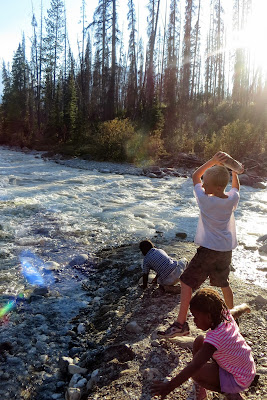


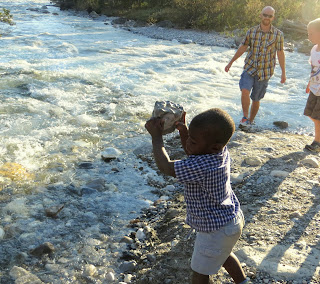


These pictures are from our Banff trip a couple of weeks ago.

Hank and Henry, dropping pebbles into the deep Marble Canyon gorge

After our Marble Canyon hike, still in Kootenay Park


"Ooh--look at this huge one, Mommy!"


Pausing during the Lake Louise hike

Lunch break at Moraine Lake
Saturday, September 28, 2013
Rainy Saturdays
I seldom aspire to recreate things I see on Pinterest. Wouldn't you know it, though, last night before bed I came upon a mouth-watering recipe for pumpkin scones that I strategically mentioned to Hank. This providentially resulted in those very scones coming out of my oven before I got out of bed this morning (I love you, Hank!).
Well, even a double batch of those gems didn't use up the large can of pumpkin puree we had on hand. So I got crafty. Last night I also saw a recipe for pumpkin play dough on Pinterest; here is the original recipe.
We used pumpkin puree, flour, and cornstarch to make our dough. We seasoned it with cinnamon, cloves, and allspice so it would smell like fall. The recipe touted the dough as "edible," although we decided "smellable" was really a more accurate description.
And voila! We had a mess! Oh yes, and a lot of fun too.


Thursday, September 26, 2013
Growing Things

Four out of the six Willis gardeners

The naked waterer

Hops


Roasted zucchini-tomato-basil pasta sauce
Wednesday, September 18, 2013
Banff Teaser
This past weekend we took an almost-spur-of-the-moment trip to one of my favorite places on earth: Banff and the surrounding area. I don't have time for a full blog post, between the post-vacation aftermath and a few more than normal appointments, meetings, and obligations. I hope to soon fill in with more details and pictures, but for now these will have to suffice:


The Fam at Lake Louise

A couple handsome hikers

Willis family and bicycle friends
Sunday, September 8, 2013
What we (think we) know about dentistry in Burundi
Medical and dental care and training are in dire need in most parts of Africa, Burundi being no exception. In fact, Burundi may be a case study for an area of greatest need. I already mentioned that Burundi ranks as one of the poorest, least developed countries in the world. Per capita annual income is something around $300. Access to medical and dental care for many years has been non-existent to the great majority of the population.
Burundi has a population of approximately 8.5 million (2008 census data of just over 8 million, 2010 census estimate of 8.4 million), and, at best count, we think there might be 10 dentists! It seems that they're mostly known as "stomatologists" (from the Greek "stoma" meaning "mouth"). I have no idea what level of dentistry is being provided--perhaps not much more than extractions and basic fillings, but we do surmise that the care is mostly rendered to the upper echelons of society in the urban areas of the country. There is, as of yet, no dental school in the country. There is no dental supply or equipment company--here in the States we have big companies like Henry-Schein, Patterson, Burkhart, etc, some of which are even publicly traded on the stock exchanges. As far as I can tell there are no dental laboratories to make crowns, bridges, dentures, or partials.
So, how can this glaring deficiency ever change? Yes, dentists can and do go on short term (1-2 week) mission trips where they see countless patients in pain and pull hundreds, if not thousands, of teeth. Along the way, those who are Christians often share the good news of Jesus in an effort to help make a more lasting difference. Many people are touched (both physically and spiritually) by this aid and effort, but the reality is that this model will never catch up with the need. We could pull teeth all day for a lifetime and the line would probably never go away. Some even claim that this model perpetuates the cycle of need and poverty.
So, what is Burundi to do? How can the people work towards a sustainable model in which they can take care of their own while growing their economy, providing education and jobs? This is where Hope Africa University comes in to play. From their website: Hope Africa University is a Christian Liberal Arts University located in Bujumbura, Burundi. The university seeks to send into African society Christian scholars and professionals who will be able to effectively apply economic, political, and social principles for the well being of African people!
Among many other academic programs, HAU has a burgeoning department of stomatology. Our understanding is that there will be two 3-year "cycles" to train dental providers. The first 3-year cycle would produce a Bachelor's in Science degree with a course load heavy in dental sciences and some clinical apprenticeship time. These (30-40?) graduates would then be able to provide some level of dental care in clinics and hospitals scattered about the country. The second cycle is intended to train in more comprehensive levels of dentistry and would be reserved for just 6-8 students. Without dental supply companies and dental laboratories I'm not sure how this will happen, but it's a start and there's much more we will learn along the way.
So this is where I might come in. Some good friends are in Burundi now at the very beginning stages of coming alongside HAU's teaching hospital at Kibuye. We are in early discussions about the possibility of having a dental clinic at the hospital where I could teach clinical dentistry as part of the apprenticeship training.
Please be in prayer for us as we continue to explore the options and learn where God would have us serve. Pray for the country and people of Burundi as they continue to work to heal and redevelop their nation. Pray for the leadership of HAU as they have many big decisions to make.
Monday, September 2, 2013
Burundi???
When we tell people that we're moving toward dental missions in Burundi we're often met with questions of "Where's Burundi?" or "I've never heard of Burundi!" So, allow me to introduce you to the country and what I know of it. All the detail you might ever need is here, but this is my little synopsis. Also, this is a good source of info, especially regarding history, economy, travel, and tourism.
Burundi, known as the Heart of Africa, is a small (10,745 square miles--about the size of Massachusetts) landlocked country in East-central Africa. It borders Rwanda to the North, Tanzania to the East and South, and the Democratic Republic of the Congo to the West. Most of the western border is along Lake Tanganyika, the second deepest and second largest lake in the world, which also happens to be the longest freshwater lake in the world.
Here's Burundi on the map:


Though this is but a brief and cursory introduction to Burundi, I'll stop here for now. I'll reserve another blog post for the more recent stabilization and growth efforts in Burundi, specifically the work of Hope Africa University and how we hope to be involved.
Read about dentistry in Burundi here.
Burundi, known as the Heart of Africa, is a small (10,745 square miles--about the size of Massachusetts) landlocked country in East-central Africa. It borders Rwanda to the North, Tanzania to the East and South, and the Democratic Republic of the Congo to the West. Most of the western border is along Lake Tanganyika, the second deepest and second largest lake in the world, which also happens to be the longest freshwater lake in the world.
Here's Burundi on the map:
Burundi is both densely populated and rural. Most people survive by subsistence farming. The country is often ranked in the poorest 5 in the world, and by some counts has the distinction of lowest per capita GDP in the world. Burundi suffered a similar civil war and genocide in the 1990s and early 2000s as did Rwanda, though it was more slow-smoldering and received little international attention. Peace and stability came in 2005 and the country has been through a process of reconciliation and rebuilding.
Much of the country is beautiful rolling hills with a mild tropical climate year round. Burundi sits just south of the equator, but much of the country is at a significant enough elevation to moderate the heat and humidity one might expect in that part of the world. The capital, Bujumbura, sits lower and the average daily temperatures there range from the low 70s to upper 80s.
Burundi is a land rich in culture and heritage, and the people are widely known to be friendly and welcoming. Drumming seems to be a bit of a national pastime and source of pride:
Read about dentistry in Burundi here.
Subscribe to:
Posts (Atom)